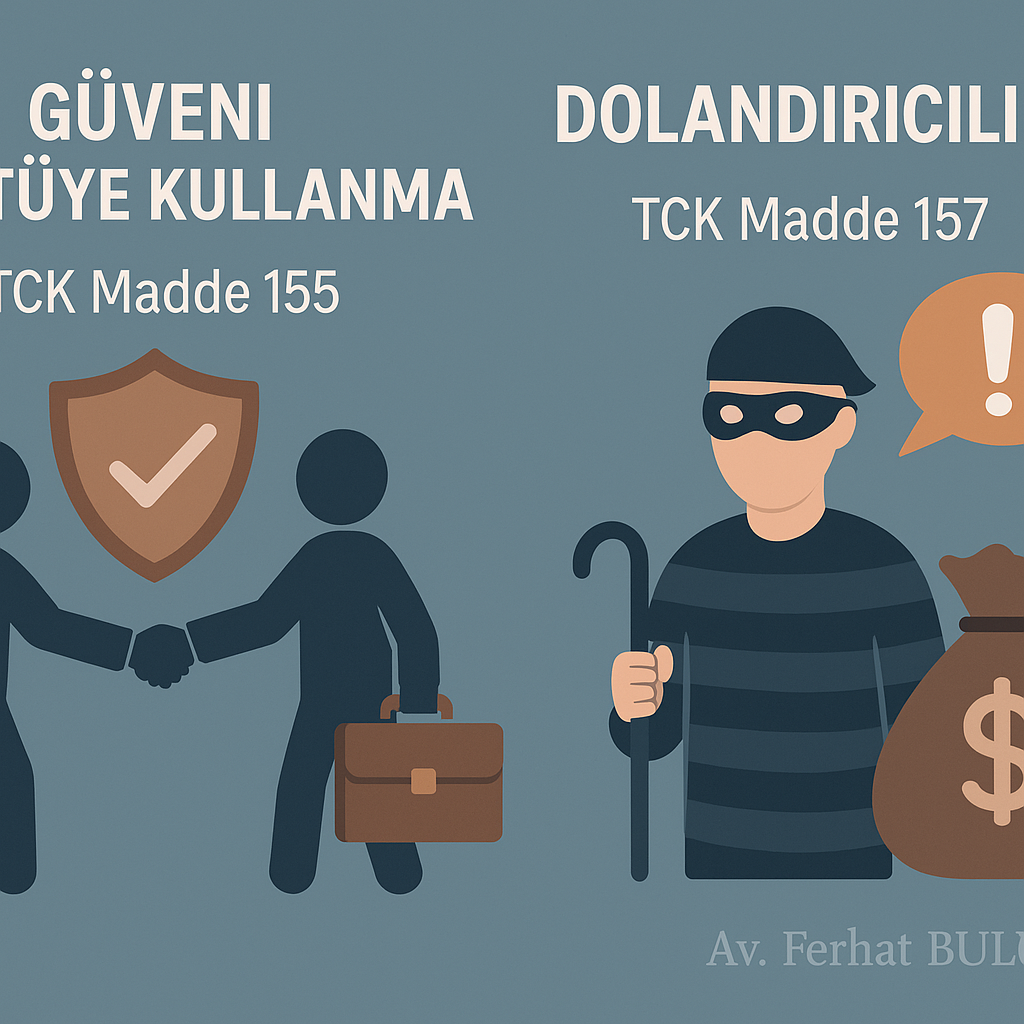


Comparison of TCK 155 Abuse of Trust and TCK 157 Fraud Crimes
The difference between TCK 155 (Using Confidence) and TCK 157 (Fraud), two of the most common crimes in criminal law practice, is significant for practitioners and judicial authorities. These two types of crime are sometimes confused and cause different consequences in practice. In this article, the elements of both crimes, their place in practice, in the light of the Supreme Court and appeals decisions will be considered in detail, and the differences between them will be embodied.
1. TCK 155 Crime of Abuse of Trust
Article 155 of the Turkish Criminal Code regulates the crime of abuse of trust. The basic state of the crime is subject to complaint, and the property in the possession of the perpetrator is formed by saving money contrary to the will of the owner.
Article text:
“A person who saves as if it were his own on property belonging to someone else and left in possession only for the purpose of surrender shall be punished with imprisonment from six months to two years.”
Its qualified status is based on the service relationship and is subject to heavier sanctions in terms of public trust.
TCK 155/2: “If the crime is committed in respect of goods entrusted to him because of a professional, artistic or commercial relationship, or any service relationship, he shall be sentenced to imprisonment from one year to seven years and a judicial fine.”
2. TCK 157 Fraud Offense
The crime of fraud according to article 157 of the TCK is defined as follows:
Article text:
“A person who deceives a person by fraudulent conduct and, to the detriment of him or someone else, benefits himself or someone else, shall be punished with imprisonment from one year to five years and a judicial fine of up to five thousand days.”
The most basic element to pay attention to in this crime is that the victim was deceived by deception. Fraudulent behavior is an act that is carried out in a planned manner with the aim of covering the will of the perpetrator and misleading the victim.
3. Comparison of Both Crimes
In the crime of abuse of trust, the victim surrendered the property to the perpetrator willingly; the perpetrator abused this trust and saved on the property.
In the case of fraud, the victim was deceived due to the fraudulent behavior of the perpetrator and handed over the goods. That is, in fraud, the victim's will to surrender is crippled.
Therefore, the crime of fraud is punished more severely.
4. Discrimination in terms of legal elements
For TCK 155:
- The goods were delivered with the consent of the victim.
- The perpetrator did not return this property or used it as if it belonged to him.
For TCK 157:
- With fraudulent behavior, the victim is deceived.
- The consent of the victim in the delivery of the goods is not legally valid.
Example: When a person does not return the car he rented, this is considered an abuse of trust, while if the rental was taken with a fake contract as if the rental never happened, it is fraud.
5. The Intent of the Perpetrator and the Moment of Crime
There is a caste that develops after the crime in the abuse of trust.The perpetrator may not be malicious at first, but later decides not to return the property.
In fraud, caste and malice are at the forefront. The perpetrator deliberately cheats and mutilates the will of the victim.
6. Resignation and Supreme Court Decisions
6.1. Supreme Court — Abuse of Trust for Service (TCK 155/2)
In its judgment of the 15th Criminal Chamber, 2019/3236 E., 2019/12452 K., the Supreme Court approved the grounds for the fundamental rejection of the application of appeal against the conviction of the accused against the accused.
6.2. Supreme Court — Simple Fraud (TCK 157)
In its judgment of the 15th Criminal Chamber, 2019/4692 E., 2019/7647 K., 08.07.2019, the Supreme Court considered it a crime of fraud whether to take the victim's mobile phone under the pretext of “borrowing” or not to return it.
7. Case Analyses
✅ Case 1: The fact that the accountant embezzled the money received to deposit insurance premiums was assessed under TCK 155/2.
✅ Case 2: Renting a tractor and using it for different purposes is considered a crime under TCK 155/1 or 155/2.
✅ Case 3: The event of receiving fraudulent money can be considered theft if the cheating was short-lived.
8. Practice Guide — How to Distinguish
1. The Time of the Mast:
- TCK 157: Caste is planned from the beginning.
- TCK 155: Caste is formed afterwards.
2. Cheating Element:
- 157: Deceitful behavior and the victim must be deceived.
- 155: The legally valid post-consent trust is abused.
3. Is it subject to complaint?
- 155/1 is subject to complaint; 155/2 is subject to immediate investigation.
- 157 simple frauds are subject to settlement, and other cases are not subject to complaint.
4. Penalty and Court:
- 155/1:6 months—2 years (Improper Sentence)
- 155/2:1—7 years (Improper Sentence)
- 157:1—5 years, judicial fine (Civil Penalty), 158: There is an increase in the sentence according to the qualification situation. (Heavy punishment)
Keywords: Abuse of trust, fraud, criminal, lawyer, severe criminal lawyer, abuse of trust and fraud offense distinction, Istanbul